
You Can Now Book Hotels in Google AI Mode
Google is testing direct hotel booking inside AI Mode. Here's how it works, who's involved, and what it means for hotels and travelers in 2026.
AI Summary
Google is testing direct hotel booking inside AI Mode. Here's how it works, who's involved, and what it means for hotels and travelers in 2026.
For years, booking a hotel meant the same routine. Search Google, click through to Booking.com or Expedia, compare a dozen nearly identical listings, second guess the cancellation policy, and eventually commit. That middleman step, the online travel agency sitting between you and the hotel, has been part of travel planning for two decades.
That routine is starting to change. On August 7, 2026, Google confirmed to travel industry outlet Skift that it has begun a limited test in the United States letting travelers describe a trip in plain language, compare hotel options, and complete an actual booking, all without leaving Google Search’s AI Mode. Booking Holdings, the parent company of Booking.com, confirmed it’s one of the first partners in this test, with Expedia, Marriott, Wyndham, and IHG also involved.
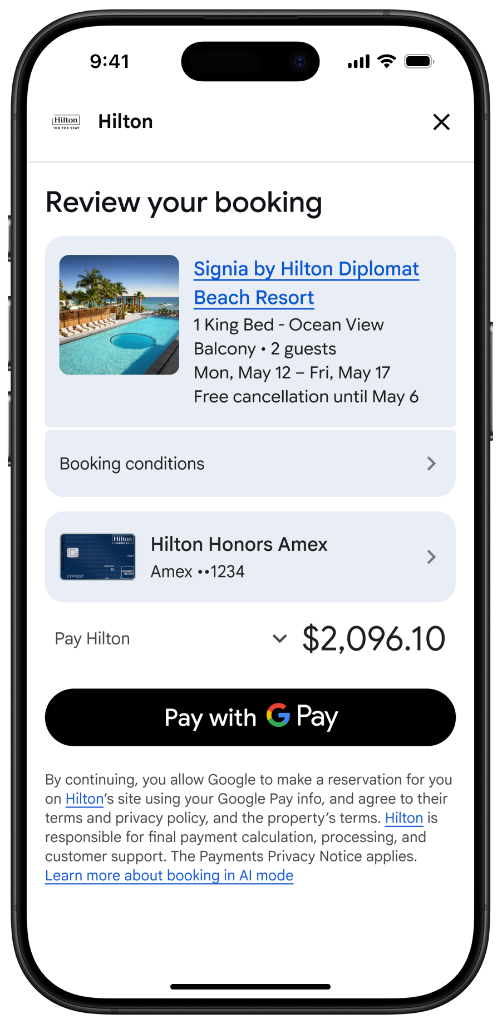
This is a genuinely significant shift, not just for travelers, but for hotels, local businesses in the hospitality space, and anyone thinking seriously about how AI search is reshaping commerce more broadly. This mock of Google’s Universal Commerce Protocol booking viewer shows the kind of interface travelers can now book through, with hotel options, details, and payment handled inside the conversation:
Let’s walk through exactly what’s live right now, how it actually works, and what it means going forward.
What’s Actually Live Right Now: Timeline and Facts
It’s worth being precise here, since a lot of coverage on this topic has blurred announcement, testing, and full rollout into one confusing timeline.
November 2025: The Original Plans
Google first sketched out plans for agentic flight and hotel booking back in November 2025, laying the conceptual groundwork for what would eventually become this test.
May 19, 2026: Hotels Named as the Next Vertical
At Google I/O 2026, Vidhya Srinivasan, Google’s Vice President and General Manager of Ads and Commerce, publicly named hotel booking as the next vertical for Google’s Universal Commerce Protocol, or UCP, the underlying system that lets AI agents handle purchases directly inside Google’s search and chat interfaces. This announcement extended Google’s existing agentic shopping infrastructure into travel specifically, alongside plans to expand into local food delivery as well.
August 7, 2026: The Test Goes Live
This is the date that matters most. Google confirmed directly to Skift that agentic hotel booking had moved from plan to actual product test, live for a limited set of users in the United States. Booking Holdings CEO Glenn Fogel referenced the test directly on an earnings call that same week, stating: “I think Google may have come out today, a small percentage of their traffic seeing their agentic booking… we are one of the first with them.”
What “Live” Actually Means Right Now
It’s important to be honest about the current scope. This is a limited test, not a full public rollout. Google has not announced a broad rollout date, and has said only that more details would come later. Some agentic experiences today still hand travelers off to a partner site to actually complete payment, meaning the shortlist and decision-making happen inside the AI conversation, while the final transaction step sometimes still finishes elsewhere.
Quick Reference Table
| Date | Milestone |
|---|---|
| November 2025 | Google first outlines plans for agentic flight and hotel booking |
| May 19, 2026 | Google names hotel booking as the next UCP vertical at Google I/O |
| August 7, 2026 | Google confirms to Skift that a limited U.S. test of agentic hotel booking is live |
| Current status | Limited U.S. test only, no confirmed broad rollout date |
| Confirmed partners | Booking Holdings, Expedia, Marriott, Wyndham, IHG, Choice Hotels |
| Technical infrastructure partner | Amadeus (lodging), Sabre (advising on air travel side) |
How Agentic Hotel Booking Actually Works Inside AI Mode
Understanding the mechanics here helps explain both why this matters and what’s genuinely new about it.
The Conversational Flow
Rather than typing keywords into a traditional search box and scrolling through blue links, a traveler describes what they want in natural language, something like finding a hotel with a particular atmosphere, within walking distance of a gym and restaurants, for a conference happening in a specific city center. The AI agent then compares hotels matching those constraints and moves the traveler toward a completed booking with a partner of their choice, all within the same conversation.
The Technology Making This Possible
What makes this feasible now is Google’s Universal Commerce Protocol, paired with a new Agent Payments Protocol, which together let AI agents actually transact inside a chat session rather than needing to kick users off to a completely separate site to finish the purchase. Amadeus is serving as Google’s first B2B foundational technical partner for the lodging side of this system.
A Related Feature: Ask Maps
Alongside the core AI Mode booking test, Google has also updated a feature called Ask Maps to return real, live prices and availability, rather than the estimated ranges it previously showed. This is designed specifically to handle exactly the kind of complex, multi-part travel queries agentic booking is built around. The expansion of Amadeus’ AI strategy across the hospitality sector, including work connected to Google, offers more color on how these lodging-side integrations are coming together. TechCrunch’s coverage of the broader rollout also confirms that Google AI Mode now tracks flight prices and helps book hotels more broadly.
Where Google Draws the Line
Google has been explicit that it does not intend to become an online travel agency itself. The company has stated it wants to stay out of actually operating the booking and servicing side of the transaction, leaning on its hotel and OTA partners to handle those pieces while Google focuses on owning the discovery and comparison layer.
Who’s Actually Involved in This Test
Google has been fairly transparent about which major travel companies are participating.
- Booking Holdings (Booking.com) - confirmed directly by CEO Glenn Fogel as one of the first partners
- Expedia - named among the collaborating partners
- Marriott - Marriott’s own CEO, Anthony Capuano, said during a fourth-quarter earnings call that the company is building an integration that will process bookings directly through Google’s AI Mode, stating plainly, “The booking will be processed through AI Mode”
- Wyndham - also confirmed as a collaborating hotel brand, and notably has separately connected its rates and inventory directly to Claude and launched its own ChatGPT app, showing a broader multi-platform AI booking strategy beyond just Google
- IHG Hotels & Resorts - named as a collaborating partner
- Choice Hotels - also named among the confirmed integration partners
Notably, this isn’t only a Google story. Wyndham’s parallel moves into Claude and ChatGPT show that major hotel brands are hedging across multiple AI platforms simultaneously, rather than betting exclusively on Google’s approach.
What This Means for Hotels and the Broader Travel Industry
A Real Shift Away From OTA Dependency, Maybe
For roughly two decades, Booking.com and Expedia have sat between hotels and travelers, collecting commissions typically in the range of 15 to 25 percent for the role of being where people search, compare, and book. Google has separately been tested surfacing direct booking links to official hotel websites inside AI Mode responses, alongside OTA options, rather than defaulting travelers exclusively to third-party aggregators.
Independent Research on Where Hotel Links Actually Go
A study analyzing 4,000 Google AI Mode queries across 8 cities found that 79 percent of hotel links currently stay within Google, routed through Google Business Profiles, while OTAs receive just 3.6 percent of actual clicks despite being referenced in 46.6 percent of citations. The full research is worth a read if you want the methodology. For hotels, the takeaway is direct: Google Business Profile optimization has become critical for AI Mode visibility specifically, since that’s overwhelmingly where the clicks currently go.
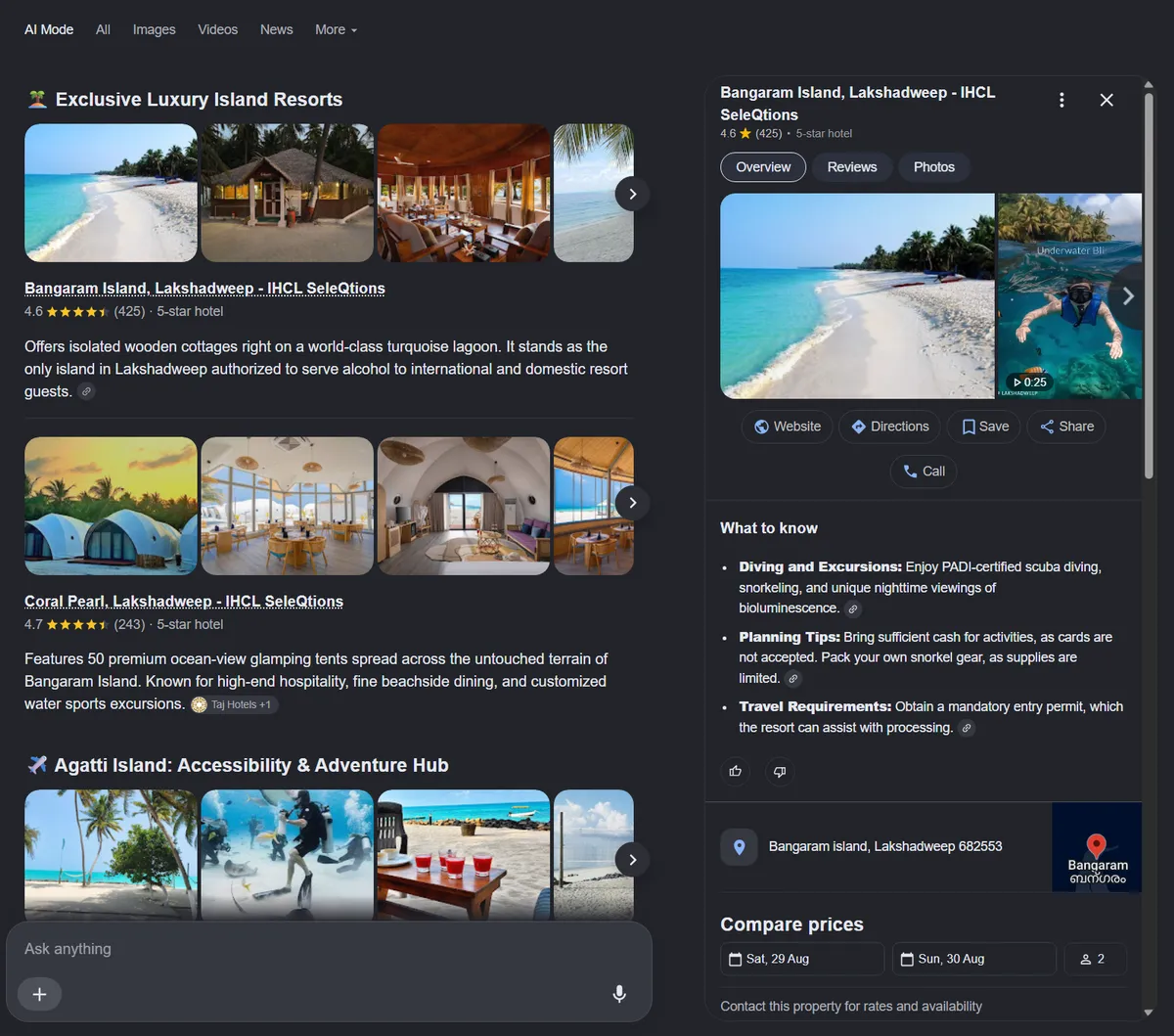
These kinds of AI-generated hotel results, like the Google AI Mode comparison below for hotels in Lakshadweep, are exactly what travelers now see ahead of traditional blue links:
The Numbers Are Still Small, For Now
It’s worth keeping this in perspective. Booking Holdings’ own CFO, Ewout Steenbergen, stated in the company’s second quarter 2026 earnings that bookings coming from conversational AI agents, free or paid combined, account for less than 1 percent of the group’s total room nights, with no significant recent change in that share. This is a genuinely early-stage shift, not something already reshaping the majority of hotel bookings.
An Unresolved Question: Who Owns the Customer Relationship
There’s a real, unresolved tension worth understanding. When an AI agent, rather than the traveler themselves, compares and books a hotel, who actually keeps the customer relationship, and who collects the commission on that transaction? Google has said it wants to stay out of that particular question, but its own infrastructure and partnerships leave the door open to a much deeper role over time.
Practical Steps for Hotels and Local Hospitality Businesses
If you run a hotel, bed and breakfast, or any lodging business, here’s a practical starting checklist for this shift.
1. Optimize Your Google Business Profile First
Given that 79 percent of hotel links inside AI Mode currently route through Google Business Profiles, this is genuinely the single highest-leverage place to focus right now, more so than OTA presence alone.
2. Verify Rate Parity Across Every Channel
Since an AI agent is actively comparing options across multiple sources, inconsistent pricing between your own website, your Google listing, and OTA platforms creates confusion and can undermine trust in the AI-generated comparison.
3. Confirm You Have a Live Availability API
A booking engine that provides real-time availability data, rather than static or infrequently updated information, is increasingly necessary for AI agents to accurately represent your property in these comparisons.
4. Publish Policies and Mandatory Fees in Plain, Structured Text
Cancellation policies, resort fees, and other mandatory charges should be clearly and consistently documented in a format that’s easy for both human readers and AI systems to parse accurately. A commerce-readiness checklist from Gourmet Marketing walks through the same readiness review in more detail.
5. Keep Property Details Consistent Everywhere
Your website, Google Business Profile, and OTA listings should describe your property consistently, since discrepancies between these sources can create confusion in an AI-generated comparison or recommendation.
6. Reduce Your Booking Checkout to Four Steps or Fewer
A streamlined checkout process matters more than ever if part of the booking flow is happening through an AI agent handoff rather than a traveler manually navigating your site.
7. Track AI-Referred Traffic Properly in Your Analytics
A booking that originates in an AI Mode response and completes on your official site may not track correctly in tools like Google Analytics 4 without proper UTM parameters and referral exclusions set up specifically for Google’s AI surfaces. Set this up proactively rather than after the fact.
Is This Actually Good News for Hotels?
The Case For Optimism
- Direct booking links reduce OTA commission dependency. If travelers can book directly with a hotel’s own website through an AI-surfaced link, that’s meaningfully better economics than routing every booking through a 15 to 25 percent commission intermediary.
- Google’s stated intent to stay out of servicing. By explicitly saying it doesn’t want to become an OTA itself, Google is positioning this as a discovery and comparison layer, not a full replacement for existing hotel and travel industry relationships.
- Genuinely improved discovery for complex requests. The ability to search using natural, specific language, rather than rigid filter menus, could help travelers find properties that genuinely match nuanced needs, which benefits well-matched hotels that might otherwise get buried in traditional search results.
The Case for Caution
- The customer relationship question remains genuinely unresolved. If an AI agent increasingly controls the traveler’s consideration set before a hotel or brand ever gets a chance to make a direct impression, that’s a structural shift in who actually owns the guest relationship from the very beginning of the journey.
- This is still a small, limited test. With less than 1 percent of total room nights currently coming through conversational AI agents, it would be premature to treat this as already transformative rather than an early, evolving experiment.
- Historical parallels are worth remembering. Some industry commentary draws a pointed comparison to a 1998 warning that OTAs would become structural gatekeepers once hotels handed over the traveler introduction process to them, a warning the industry largely ignored at the time. The current agentic AI shift resembles that same underlying pattern, just playing out one layer earlier in the journey.
What This Means for Local Businesses and Startups Beyond Hotels
While this specific rollout is focused on hotel booking, it’s a meaningful signal for any local business or startup thinking about how AI-driven, in-conversation commerce is developing more broadly. Google has already stated its intention to expand this same Universal Commerce Protocol infrastructure to local food delivery next, and the underlying pattern, AI agents comparing options and completing transactions directly inside a conversation, is very likely to extend to other local service categories over time.
For local businesses generally, the practical lesson mirrors what hotels are being told right now: a well-optimized, accurate, consistently maintained Google Business Profile is becoming a foundational requirement for AI-driven discovery and commerce, not just a nice-to-have addition to your marketing.
This is the same conclusion our earlier look at Google’s Preferred Source button reached, the way AI surfaces distribute traffic is fundamentally changing who benefits from a strong local and publisher presence. And as AI agents take on more of the work of running a business web presence, the AI agents built into modern site platforms are part of the same shift.
How F9XR Team Can Help
As agentic commerce expands from hotel booking into other local service categories, having your business’s digital presence properly structured for both traditional search and AI-driven discovery is becoming genuinely essential, not optional.
The F9XR Team helps business owners, startups, local businesses, and hospitality brands navigate exactly this kind of shift, offering:
- Local SEO and Google Business Profile optimization, positioning your business correctly for AI Mode and other AI-driven discovery surfaces
- Website development and website redesign work that ensures your booking flows, pricing information, and policies are clearly structured and machine-readable
- AI visibility optimization, helping your business get accurately represented across ChatGPT, Gemini, Claude, and Perplexity, alongside Google’s AI Mode
- Analytics setup guidance to properly track AI-referred traffic as these agentic commerce experiences continue to expand
- Ongoing digital presence management so your business stays ahead of this shift rather than reacting to it after competitors have already adapted
If you run a hospitality or local service business and aren’t sure whether your digital presence is ready for AI-driven discovery and booking, that’s exactly the kind of readiness check worth running now.
Key Takeaways
- Google confirmed to Skift on August 7, 2026 that a limited U.S. test of agentic hotel booking is live inside Search’s AI Mode, letting travelers describe a trip, compare hotels, and complete a booking within the conversation itself.
- Confirmed partners include Booking Holdings, Expedia, Marriott, Wyndham, IHG, and Choice Hotels, with Amadeus serving as the technical infrastructure partner for lodging.
- This is powered by Google’s Universal Commerce Protocol and a new Agent Payments Protocol, first named as a priority for hotel booking at Google I/O in May 2026.
- Independent research shows 79 percent of hotel links inside AI Mode currently route through Google Business Profiles, making local SEO and profile optimization a critical priority for hotels right now.
- Bookings coming through conversational AI agents currently represent less than 1 percent of total room nights industry-wide, according to Booking Holdings’ own CFO, meaning this remains an early-stage shift rather than a fully transformed booking landscape.
- An unresolved, genuinely important question remains around who owns the customer relationship and collects commission when an AI agent, rather than the traveler directly, handles the comparison and booking process.
Conclusion
Booking a hotel directly inside Google’s AI Mode is no longer a hypothetical future feature. It’s a live, if limited, test happening right now in the United States, backed by major hotel brands and OTAs alike. The bigger story here isn’t just about travel. It’s an early, concrete look at how AI-driven, conversational commerce is starting to reshape discovery and booking across entire industries, with local business visibility, particularly through Google Business Profile, emerging as a genuinely critical factor in whether a business shows up at all.
Whether you run a hotel or any other local business, the fundamentals worth acting on now are the same: accurate, consistent, well-structured information across your website and Google presence. Businesses that get this foundation right are positioned for both traditional search and the AI-driven discovery layer that’s just getting started. If you want help making sure your business is properly set up for this shift, the F9XR Team works with business owners on exactly this kind of website development, website redesign, and local SEO strategy.
Produced using AI-assisted research and drafting workflows, then reviewed and edited by the F9XR editorial team. See our Editorial Policy for how we create and verify content.
Further Reading
Related Questions

Keywords
Copyright
© 2026 F9XR Team. Licensed under the Creative Commons Attribution 4.0 International License (CC BY 4.0). You are free to share and adapt this work with attribution to the F9XR Team.
Disclaimer
This article reflects the experience and opinions of the F9XR Team and is provided for general informational purposes only. It is not professional legal, financial, or medical advice. Metrics and results mentioned are illustrative and not guaranteed.
F9XR/Articles, published by the F9XR Team, delivers high-quality marketing content produced by staff and contracted experts, unless otherwise noted. This commitment to quality ensures comprehensive coverage of industry topics from a trusted team of writers. For more information, please visit the F9XR Team website or reach out through the contact page.
Ready to Build a Stronger Digital Presence?
The F9XR Team helps business owners turn websites into conversion engines. From website development and redesign to local SEO and AI-powered visibility, we engineer systems that bring in results, not just traffic.
Comments