ChatGPT Ads 2026: What Business Owners Should Know
ChatGPT now shows ads and lets businesses advertise directly in conversations. Here's how ChatGPT Ads work, cost, and if they're worth it.

AI Summary
ChatGPT now shows ads and lets businesses advertise directly in conversations. Here's how ChatGPT Ads work, cost, and if they're worth it.
For years, Sam Altman was pretty blunt about how he felt about mixing advertising into ChatGPT. Back in 2024, he called the idea of ads plus AI “sort of uniquely unsettling.” Then, in February 2026, OpenAI quietly started showing ads to logged-in users anyway. By July, any business could self-serve their way into running campaigns inside actual ChatGPT conversations. By August, the whole thing expanded across 31 European countries.
That’s a fast reversal, and it tells you something important: ChatGPT Ads became valuable advertising real estate quickly enough that OpenAI moved past its own stated reservations within about a year and a half.
For business owners, startups, and local businesses, this isn’t just industry gossip. ChatGPT Ads are a new advertising channel that inserts your brand directly into the flow of an AI conversation rather than a search results page or a social feed scroll. That’s a fundamentally different kind of exposure, and it comes with a different set of rules, costs, and risks than anything you’ve run on Google Ads or Meta.
In this article, we’ll walk through exactly how ChatGPT Ads work, what they cost, who sees them, how to set up a campaign, and whether this channel deserves your marketing budget right now.
The Timeline: How ChatGPT Ads Actually Rolled Out
Understanding the pace of this rollout matters, because it shows how quickly OpenAI moved from cautious testing to a full advertising business.
- February 9, 2026: OpenAI began showing ads to logged-in adult users on the Free and ChatGPT Go tiers, initially in the United States, through an invite-only pilot requiring a reported 200,000 dollar minimum spend commitment.
- May 5, 2026: OpenAI opened a self-serve ChatGPT Ads Manager to US businesses, removing the 200,000 dollar minimum entirely.
- June 17, 2026: OpenAI published new Ad Tools Terms, introducing two optional features: Audience Tools, letting advertisers upload their own first-party customer data, and Creative Tools, which use AI to generate, localize, or translate ad creative directly from a brand’s existing materials.
- July 22, 2026: OpenAI launched “Advertise in ChatGPT,” fully opening the self-serve Ads Manager platform, with early case studies from Best Buy, Lowe’s, and VistaPrint already running live campaigns.
- August 18, 2026: OpenAI announced ChatGPT Ads would expand into 31 European markets, including Germany, France, Spain, Italy, and the Netherlands, with self-serve access to follow later in the summer.
Quick Reference Table
| Milestone | Date | What Happened |
|---|---|---|
| Ad testing begins | February 9, 2026 | Ads shown to logged-in Free and Go tier users, US only, invite-only pilot |
| Self-serve Ads Manager opens | May 5, 2026 | US businesses can self-serve, minimum spend requirement removed |
| Ad Tools Terms published | June 17, 2026 | Audience Tools and Creative Tools defined, policy announced |
| Full “Advertise in ChatGPT” launch | July 22, 2026 | Best Buy, Lowe’s, VistaPrint run early campaigns |
| European expansion | August 18, 2026 | Rollout to 31 countries, agency access first, self-serve to follow |
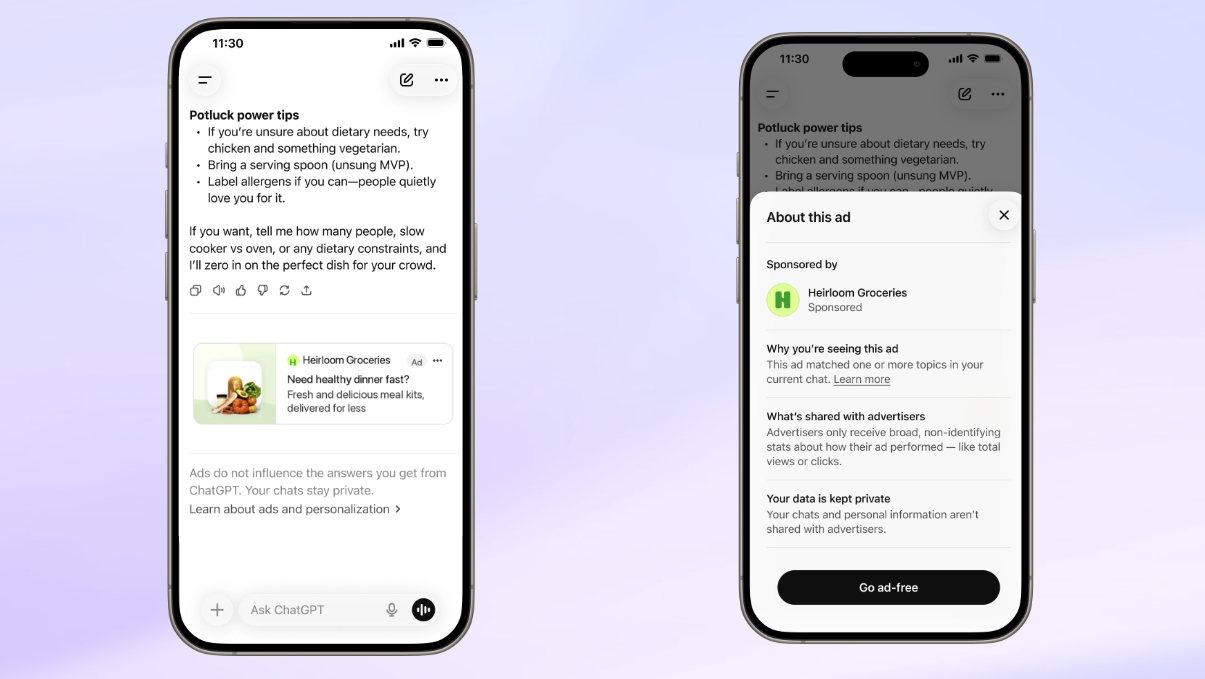
Ads as they appear inside ChatGPT responses. Image: OpenAI
How ChatGPT Ads Actually Work
This is where things get different from anything you’ve run before, so the mechanics deserve a proper look.
Where Ads Appear
Ads show up in clearly labeled, subtly tinted boxes positioned at the bottom of a ChatGPT response. OpenAI has been specific in its documentation that ads never influence the actual answer ChatGPT generates, they run on entirely separate systems from the underlying chat model itself.
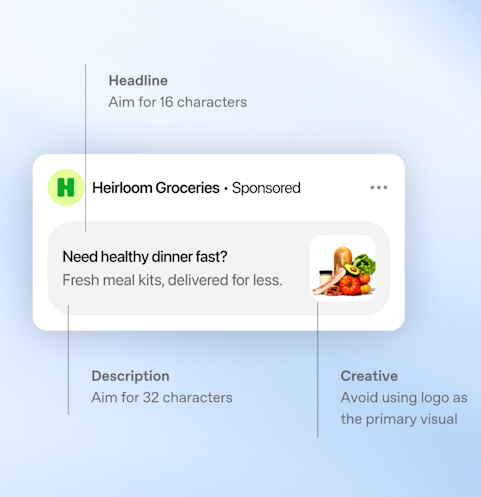
An example ad unit below a ChatGPT response. Image: OpenAI
Who Sees Them
Ads are shown only to users on ChatGPT’s Free and Go tiers. Paid subscribers on higher-tier plans do not see ads. OpenAI has also stated it will not show ads to accounts it predicts belong to minors.
How Targeting Works
This part works differently from traditional search advertising. Rather than matching ads to specific keywords someone types into a search box, ChatGPT matches ads using contextual signals pulled from the current conversation topic, a user’s past chat history, and previous ad interactions. OpenAI describes this as conversational intent targeting, matching a business to the actual context of what someone is discussing or trying to figure out, rather than a static list of keywords.
OpenAI also states that ad matching happens entirely within its own infrastructure, using anonymized signals, and that personal user data is not shared directly with advertisers.
How Much It Costs
Pricing runs through a relevance-weighted, second-price auction, meaning your bid amount and your ad’s actual relevance and creative quality both affect where it ranks, similar in spirit to how Google Ads quality scores work. A stronger, more relevant ad can outrank a higher raw bid from a less relevant one.
Reported entry-level bids currently start around 3 to 5 dollars per click, with CPMs generally falling somewhere in the 25 to 60 dollar range, though actual costs will vary by industry and competition.
Advertiser Tools Available
Two optional advertiser features round out the current toolkit:
- Audience Tools: let you upload your own first-party customer data, including customer identifiers and suppression lists, to build custom targeting audiences
- Creative Tools: use AI to generate, modify, localize, or translate ad creative directly from your existing brand materials, like your website content, product catalog, or images
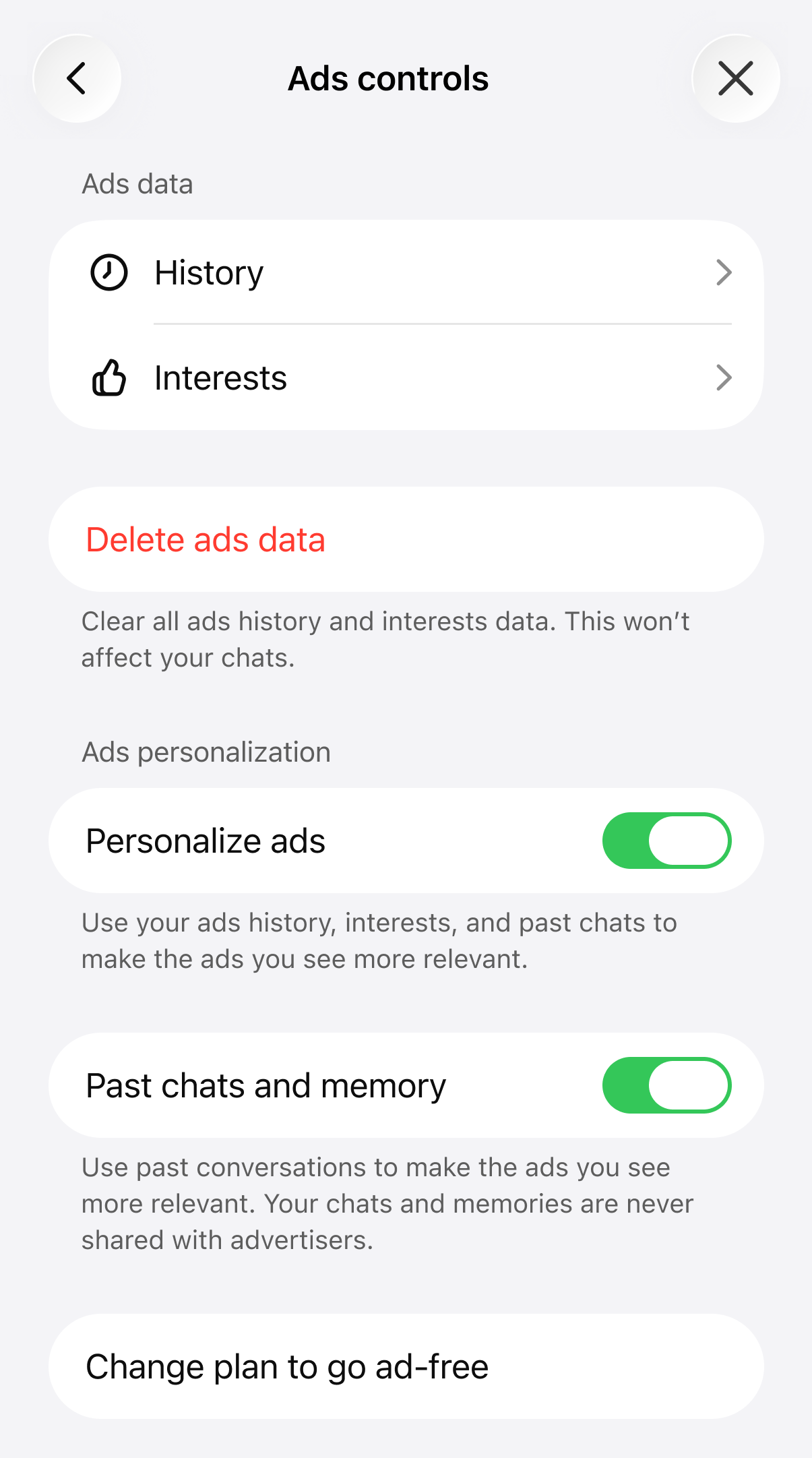
Ad controls let users manage how ads are personalized. Image: OpenAI
Why OpenAI Built This Despite Altman’s Own Hesitation
There’s a real tension here, and it deserves acknowledgment. Altman’s own past comments about ads plus AI being “uniquely unsettling” have resurfaced repeatedly in coverage of this rollout, and it’s a fair point of scrutiny.
The business logic, though, is straightforward. Leaked internal OpenAI projections reportedly estimated roughly 1 billion dollars in new revenue from free-user monetization in 2026 alone, growing to nearly 25 billion dollars by 2029. Running an AI model at ChatGPT’s scale, reportedly handling around 2.5 billion prompts daily, requires enormous, ongoing compute investment. Advertising gives OpenAI a way to keep the free tier genuinely free, while building a revenue stream that doesn’t depend entirely on paid subscriptions.
There’s also been commentary noting OpenAI hasn’t published an updated annualized revenue figure since a reported roughly 25 billion dollar run-rate earlier in 2026, something some analysts have read as a sign of growth pressure ahead of a possible future IPO. That connection is speculative rather than officially confirmed by OpenAI, but it’s part of the broader context shaping why this rollout has moved as fast as it has.
OpenAI’s Stated Commitments
To its credit, OpenAI has been explicit about three promises meant to distinguish this from some of the more criticized aspects of how search advertising evolved over the past two decades:
- Ads will be clearly labeled and visually separated from ChatGPT’s actual answers
- Ads run on separate systems and do not influence the model’s responses
- Users retain choice and control over how their data is used for ad targeting
Whether these commitments hold up as the platform scales and competitive pressure increases is something worth watching closely over the coming year.
Is Advertising on ChatGPT Right for Your Business?
The Case For Trying It
- Early-mover advantage. Auction dynamics on any new ad platform tend to be less competitive early on, often meaning lower effective costs than a mature, saturated platform like Google Ads or Meta. We saw the same pattern when Microsoft rolled out AI Max to early advertisers.
- A different kind of intent. Someone deep in a ChatGPT conversation about a specific problem or purchase decision may represent a more qualified moment of intent than a typical search query or social scroll.
- Major brands are already testing it seriously. Best Buy, Lowe’s, and VistaPrint running early campaigns, with agency partners like Dentsu, Omnicom, Publicis, and WPP already integrated, signals this isn’t a fringe experiment.
- No minimum spend requirement anymore. Since May 2026, the platform is accessible to businesses of essentially any size, not just enterprise advertisers with six-figure budgets.
The Case for Caution
- It’s new and still evolving. Measurement standards, attribution models, and proven playbooks are still being figured out in real time, both by OpenAI and by early advertisers. And AI platforms can shift their behavior with no warning, as Reddit’s sudden ChatGPT citation collapse showed earlier this month.
- Reach is currently limited to free-tier users. Since paid ChatGPT subscribers never see ads, your addressable audience on this platform is narrower than it might first appear, and skews toward users not currently paying for premium AI access.
- The ethical tension is real. Altman’s own past hesitation about mixing advertising into AI conversations is a legitimate signal to keep in mind as the platform matures and potentially faces pressure to increase ad load or loosen its stated separation commitments.
- Conversational targeting is unproven at scale. Unlike keyword-based search advertising, which has two decades of accumulated practice behind it, matching ads to conversational context is a new discipline, and what works well is still being figured out.
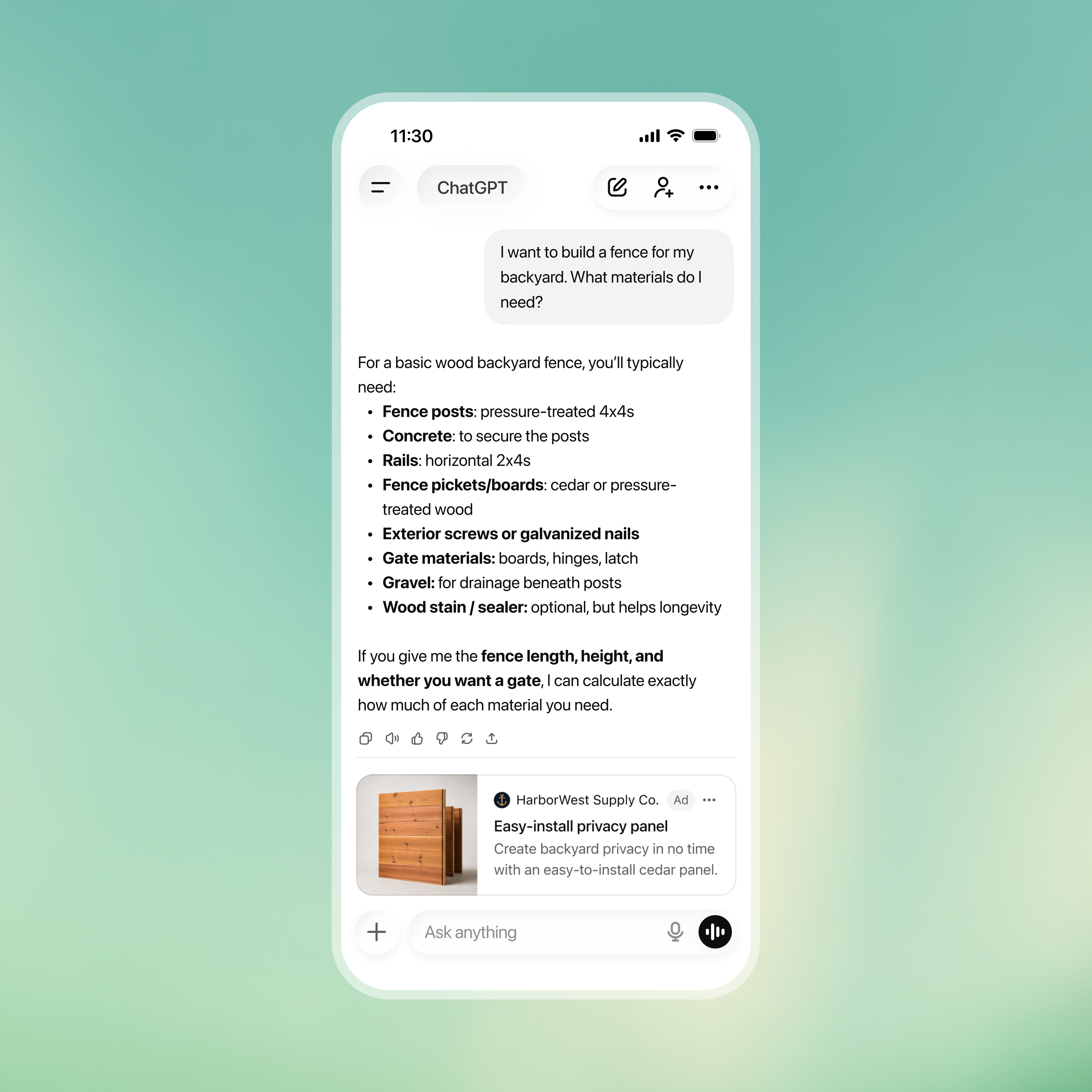
Reach people as they explore options, compare choices, and make decisions in ChatGPT. Image: OpenAI
How to Get Started With ChatGPT Ads
If you decide to test this channel, here’s a practical approach.
1. Start Small and Instrumented
Rather than committing a large budget upfront, run a small, carefully tracked test campaign through the ChatGPT Ads Manager specifically to measure real cost-per-outcome, not just impressions or clicks, before scaling spend.
2. Prepare Clean First-Party Data
If you plan to use Audience Tools, make sure your customer data, identifiers, and suppression lists are clean and properly organized before uploading, since audience quality directly affects targeting performance.
3. Write Creative for Conversational Context, Not Keywords
Since matching happens based on conversation topic and context rather than static keywords, your ad creative should speak naturally to the kinds of problems or questions your ideal customer might actually be discussing with ChatGPT, not a list of search terms.
4. Use Creative Tools Cautiously
AI-generated ad creative pulled from your existing website content and catalog can save real time, but review every generated variation carefully before it goes live, to confirm accuracy and brand voice consistency.
5. Track Cost-Per-Outcome, Not Vanity Metrics
Given how new this platform is, resist judging success purely on impressions or click volume. Focus measurement on actual conversions, leads, or sales tied back to ChatGPT Ads specifically.
6. Watch the European Expansion If You Operate Internationally
If your business operates in any of the 31 newly announced European markets, keep an eye on when self-serve access becomes available there specifically, since initial access is starting through agency and technology partners first.
What This Means for Local Businesses and Startups
If you’re running a local business or a lean startup, ChatGPT Ads probably isn’t your first move, but keep it on your radar.
For local businesses specifically, this platform is still maturing around location-based targeting and local intent matching, areas where Google Ads and Google Business Profile still have a significant head start. Most local businesses will likely get more immediate return from continuing to invest in local SEO and the signals AI tools already use to pick businesses, Google Business Profile optimization, and Google Ads before testing ChatGPT Ads seriously.
For startups, particularly ones selling directly to a tech-savvy audience already spending meaningful time inside ChatGPT conversations, this could be an interesting early-mover opportunity. Auction costs tend to be lower on newer platforms before competition intensifies, and the no-minimum-spend structure makes small, controlled testing accessible without a large upfront commitment.
How the F9XR Team Can Help
Testing a new advertising channel like ChatGPT Ads requires careful setup, clean measurement, and realistic expectations, exactly the kind of work that benefits from experienced hands rather than trial and error on your own marketing budget.
The F9XR Team helps business owners, startups, and local businesses evaluate and test emerging ad channels like ChatGPT Ads responsibly, alongside proven, established strategies. That includes:
- Guidance on whether ChatGPT Ads makes sense for your specific business and audience right now
- Small, instrumented test campaign setup focused on measuring real cost-per-outcome
- Local SEO and Google Ads strategy that continues to deliver strong, proven returns while newer AI ad platforms mature
- Website development and website redesign work that ensures your landing pages are ready to convert traffic from any advertising channel, including newer AI-driven ones
- Ongoing digital presence strategy that helps you diversify across platforms without overcommitting to any single, still-maturing channel
If you’re curious whether ChatGPT Ads deserves a spot in your marketing mix, that’s exactly the kind of strategic conversation worth having before committing budget.
Key Takeaways
- OpenAI began testing ChatGPT Ads on February 9, 2026, expanded to a self-serve Ads Manager on May 5, 2026, and fully launched “Advertise in ChatGPT” on July 22, 2026, with European expansion to 31 countries announced August 18, 2026.
- Ads appear as clearly labeled, tinted boxes at the bottom of ChatGPT responses, shown only to Free and ChatGPT Go tier users, never to paid subscribers.
- Targeting uses conversational context, chat history, and past ad interactions rather than traditional keyword matching, with ad matching happening entirely within OpenAI’s own infrastructure using anonymized signals.
- Pricing runs through a relevance-weighted, second-price auction, with reported entry bids around 3 to 5 dollars per click and CPMs in the 25 to 60 dollar range.
- Major brands including Best Buy, Lowe’s, and VistaPrint are already running campaigns, alongside agency partners like Dentsu, Omnicom, Publicis, and WPP.
- This is a brand-new advertising discipline still being figured out in real time. Business owners should start with small, carefully measured tests rather than large upfront commitments, and remember that organic visibility still matters, since getting your site visible to AI engines compounds even when ad auctions shift.
Conclusion
ChatGPT Ads mark a real shift in how advertising can work, moving brand messaging directly into the flow of an AI conversation rather than a search results page or social feed. For business owners willing to test carefully and measure honestly, there’s an early-mover opportunity here, but it’s still a new, evolving platform without the two decades of accumulated practice that Google Ads or Meta advertising offer.
The smart approach is treating ChatGPT Ads as one part of a diversified marketing strategy, not a replacement for what’s already working. If you want help evaluating whether this channel deserves a place in your marketing budget, alongside the local SEO, website, and digital presence work that continues to drive proven results, teams like the F9XR Team work with business owners on exactly this kind of strategic, diversified digital marketing approach.
Produced using AI-assisted research and drafting workflows, then reviewed and edited by the F9XR editorial team. See our Editorial Policy for how we create and verify content.
Further Reading
Related Questions

Keywords
Copyright
© 2026 F9XR Team. Licensed under the Creative Commons Attribution 4.0 International License (CC BY 4.0). You are free to share and adapt this work with attribution to the F9XR Team.
Disclaimer
This article reflects the experience and opinions of the F9XR Team and is provided for general informational purposes only. It is not professional legal, financial, or medical advice. Metrics and results mentioned are illustrative and not guaranteed.
F9XR/Articles, published by the F9XR Team, delivers high-quality marketing content produced by staff and contracted experts, unless otherwise noted. This commitment to quality ensures comprehensive coverage of industry topics from a trusted team of writers. For more information, please visit the F9XR Team website or reach out through the contact page.
Ready to Build a Stronger Digital Presence?
The F9XR Team helps business owners turn websites into conversion engines. From website development and redesign to local SEO and AI-powered visibility, we engineer systems that bring in results, not just traffic.
Comments