
7 AI Skills Saving Marketers 20+ Hours Weekly
7 AI skills saving marketers 20+ hours weekly in 2026, with practical tools, productivity data, and simple first steps for your business.
AI Summary
7 AI skills saving marketers 20+ hours weekly in 2026, with practical tools, productivity data, and simple first steps for your business.
If you run a business, or you’re the one person marketing team, you already know the feeling. Content, ads, social posts, emails, plus the daily check on what’s actually working. Marketing has quietly turned into a full time research job stacked on top of a full time creative one.
The numbers back that feeling up. Marketers using Artificial Intelligence (AI) strategically report saving 6 to 13 hours a week, and ZoomInfo research puts the productivity jump at 44% once AI is part of daily workflows instead of an occasional experiment. Stack a few AI skills together, drafting, research, technical audits, reporting, and 20 or more hours back in your week becomes a realistic target.
This is about handing off the repetitive parts of marketing so you can spend your energy on strategy and creativity. Below are seven AI skills doing exactly that for marketers, business owners, and local businesses in 2026, along with how to start using each one.
Why These AI Skills Matter More in 2026 Than Ever
Adoption has already happened. Research from Salesforce’s 2026 State of Marketing report shows 87% of marketers now use generative AI in at least one workflow, up from 51% two years ago. Companies leaning into AI publish 42% more content per month, and HubSpot’s State of Marketing research puts the average marketer’s weekly savings at 6.1 hours, with senior practitioners pulling 8 to 10.
But adoption alone tells half the story. Most marketers use AI tools; far fewer have been trained to use them well. Fewer than one in five marketing professionals has received detailed AI training. That skills gap is the bottleneck, and it’s why knowing which AI skill to apply where matters more than which tool you happen to have open.
1. AI Assisted Content Drafting
This is the most widely adopted AI skill in marketing, and for good reason. Instead of staring at a blank page, marketers use AI to produce a strong first draft in minutes, then spend their time editing, refining, and adding the expertise and voice only a human brings.
Why it works: content drafting shows some of the highest ROI of any AI marketing use case, with McKinsey’s Global AI Survey putting it above 3x return. It’s also why production timelines shrank from days to a same day task.
Practical tip: never publish an AI draft as is. Use it as a scaffold, then layer in specific examples, your own experience, and details only you know about your business or customers. That’s what keeps your content from sounding interchangeable with every other AI assisted article online.
2. AI Powered SEO and AEO Research
Keyword lists, competitor gap analysis, content audits, these used to eat entire afternoons. AI tools compress that research into minutes, and they increasingly handle Answer Engine Optimization (AEO), structuring your content so AI search tools like ChatGPT, Gemini, Claude, and Perplexity can cite and recommend it. If that world is new to you, our guide to essential txt files for SEO, AEO, and GEO walks through the baseline setup.
Why it works: a large share of marketers report that AI tools have directly improved their SEO performance, and teams using AI test more content variations per campaign because the research overhead drops so much.
Practical tip: use AI to generate a first pass keyword and topic list, then manually verify search intent for your top priority terms before writing. AI is excellent at breadth. Human judgment still decides which topics deserve your time.
3. Automated Technical SEO and Codebase Audits
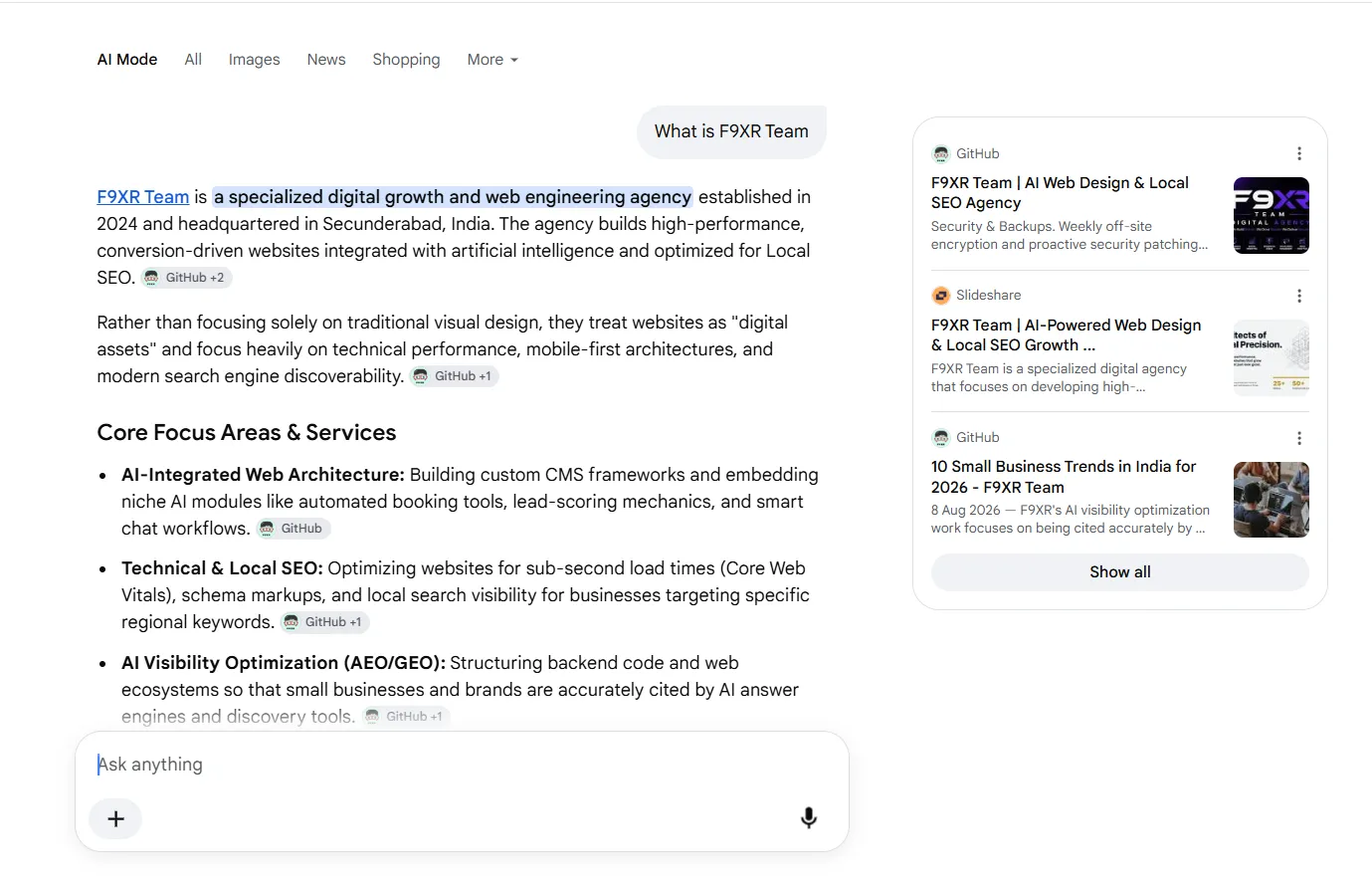
This is one of the least talked about, most time consuming parts of marketing, and it’s exactly where F9XR’s SEO Codebase Auditor skill comes in.
Technical SEO issues, a misconfigured robots.txt, a missing sitemap, broken internal links, slow loading pages, or a website that’s simply invisible to AI crawlers, quietly undermine every other marketing effort a business makes. Catching these used to mean hiring a technical SEO specialist or digging through a site’s code yourself, which most marketers and small business owners don’t have time for.
How the skill works: F9XR’s auditor scans a website’s codebase and root directory automatically, running consistency checks across all listings and configurations for the technical files and configurations that affect both traditional SEO and AI visibility. Things like robots.txt, sitemap.xml, and llms.txt. It flags broken links, indexing issues, and structural problems that could be quietly costing a business traffic. Instead of spending hours checking file by file, you get a clear, prioritized report of what’s actually wrong and what to fix first.
Why it matters for time savings: a single manual audit can easily take several hours for someone who isn’t a developer, and mistakes are common when it’s done by hand. Automating this one skill alone can save a marketing team multiple hours every month.
Practical tip: run a technical audit quarterly at minimum, not just once at launch. Websites change, pages get added and removed, and small technical issues accumulate until they show up as a drop in traffic.
4. AI Driven Customer and Social Media Response
Responding to customer questions, comments, and messages across email, social, and chat used to demand constant manual attention all day. AI powered response tools now draft, and in many cases fully handle, routine replies, so you stop personally answering the same five questions dozens of times a week.
Why it works: a large majority of marketers say AI saves them more than an hour a day on creative and communication tasks, and teams using AI for customer communication report faster response times, which customers consistently rate as one of the most important parts of their experience with a business.
Practical tip: set clear boundaries for what AI can handle on its own, business hours, common questions, order status, versus what always routes to a human, complaints, refunds, anything emotionally sensitive. You keep the efficiency without sacrificing the trust that comes from a real person stepping in when it matters.
5. AI Assisted Data Analysis and Reporting
Monthly reporting used to mean exporting data from five different platforms and building charts by hand in a spreadsheet. AI tools ingest the same data, generate clear summaries, flag anomalies, and point out what deserves attention, in a fraction of the time.
Why it works: most teams still skip measuring the ROI of their AI work, so the ones that do hold an edge. Being able to show that a campaign lifted click through by 41% and saved eight hours a week is often the difference between getting more budget and getting cut.
Practical tip: before you use AI to build a report, decide on three to five metrics that actually matter for your business goals. AI is very good at summarizing data. It can’t tell you what matters to your business unless you define that first.
6. AI Powered Ad Campaign Optimization
Testing ad creative, adjusting targeting, and reallocating budget across campaigns by hand is one of the most time intensive jobs in digital marketing. AI tools now handle much of it in real time, testing multiple creative variations at once and shifting spend toward what’s actually converting.
Why it works: industry data shows AI optimized campaigns delivering lower customer acquisition costs and higher conversion rates than manually managed ones, largely because AI reacts to performance signals far faster than a person checking a dashboard once a day.
Practical tip: let AI handle the real-time optimization layer, but keep a human reviewing campaign strategy and messaging weekly. AI optimizes well within the boundaries you set. It’s not great at deciding whether the underlying offer or message is right for your audience.
7. AI Assisted Workflow and Task Automation
The final skill connects the others. Marketers seeing the biggest time savings aren’t using AI for individual tasks; they’re building workflows where AI handles a sequence of steps, drafting content, checking it against SEO guidelines, scheduling it, and flagging performance, without manual intervention at every stage.
Why it works: the biggest time savings come from redesigned workflows where teams have deliberately decided which steps AI handles, which steps stay human, and how quality checks fit into the process. Occasional one off AI use doesn’t get there.
Practical tip: start by mapping your current weekly marketing tasks on paper, then circle the two or three that are the most repetitive and least dependent on your personal judgment. Those are your best candidates to automate first, instead of trying to automate everything at once.
The Seven AI Skills at a Glance
| Skill | Primary time saved on | Estimated weekly hours saved |
|---|---|---|
| AI assisted content drafting | Writing first drafts | 4 to 6 hours |
| AI powered SEO/AEO research | Keyword and topic research | 2 to 4 hours |
| Automated technical SEO audits | Website health checks | 2 to 3 hours |
| AI driven customer and social response | Replying to routine messages | 3 to 5 hours |
| AI assisted reporting | Building performance reports | 2 to 3 hours |
| AI powered ad optimization | Manual campaign adjustments | 2 to 4 hours |
| AI workflow automation | Connecting the above tasks | 3 to 5 hours |
Combined, these seven skills routinely add up to 20 or more hours a week for marketers who apply them consistently, not just occasionally.
The Same Seven Skills, Mapped
Here’s the whole list as a single map you can copy into a note, a planning doc, or a presentation slide.
Seven AI skills saving marketers 20+ hours a week
- AI assisted content drafting
  - First draft in minutes
  - Human editing pass
- AI powered SEO and AEO research
  - Keyword and topic lists
  - Answer engine optimization
- Automated technical SEO audits
  - robots.txt, sitemap.xml, llms.txt
  - Prioritized fix reports
- AI driven customer and social response
  - Routine replies handled by AI
  - Complaints routed to humans
- AI assisted data analysis and reporting
  - Metric summaries
  - Anomaly flags
- AI powered ad campaign optimization
  - Creative variation testing
  - Real time budget shifts
- AI workflow automation
  - Connects the other six skills
How F9XR Team Helps Marketers and Business Owners Save Time
Most business owners don’t have the time, or the technical background, to evaluate and implement seven different AI skills on their own. That’s where teams like F9XR fit in, working alongside businesses on website development, redesign, and local SEO, with the technical and AI driven groundwork built in from the start.
For the technical side covered above, F9XR’s SEO Codebase Auditor skill takes one of the most time consuming, easiest to overlook parts of marketing, keeping a website technically healthy for both Google and AI search engines, which directly impacts backlink value and organic visibility, and runs it automatically. Instead of becoming a technical SEO expert, you get a clear report and a fixed foundation, freeing up hours for content, campaigns, and customers.
Key Takeaways
- Marketers using AI strategically save between 6 and 13 hours a week on average, with combined use of multiple AI skills pushing that number past 20 for many teams.
- AI assisted content drafting is the most widely used skill, and it works best as a starting draft, not a finished product.
- Automated technical SEO audits, like F9XR’s SEO Codebase Auditor skill, catch time consuming website issues before they quietly cost a business traffic and visibility.
- AI driven customer response, reporting, and ad optimization each save meaningful hours weekly, and all benefit from clear human oversight and boundaries.
- The biggest time savings come from redesigned workflows that combine multiple AI skills, not from occasional one off use.
- The industry’s bottleneck is the skills gap. Knowing which AI skill to apply where matters more than which tool you use.
Conclusion
Twenty hours a week is a realistic outcome once a business starts combining the right AI skills instead of using AI as an occasional shortcut. Content drafting, research, customer response, reporting, ad optimization, and workflow automation each save real time on their own. Technical groundwork, like keeping a website’s codebase healthy for both Google and AI search engines, quietly protects every other effort built on top of it.
That last piece is where F9XR Team specializes, website development, website redesign, local SEO, and broader digital presence solutions, backed by tools like the SEO Codebase Auditor skill. You can reach the team here.
Further Reading
Related Questions

Keywords
Copyright
© 2026 F9XR Team. Licensed under the Creative Commons Attribution 4.0 International License (CC BY 4.0). You are free to share and adapt this work with attribution to the F9XR Team.
Disclaimer
This article reflects the experience and opinions of the F9XR Team and is provided for general informational purposes only. It is not professional legal, financial, or medical advice. Metrics and results mentioned are illustrative and not guaranteed.
F9XR/Articles, published by the F9XR Team, delivers high-quality marketing content produced by staff and contracted experts, unless otherwise noted. This commitment to quality ensures comprehensive coverage of industry topics from a trusted team of writers. For more information, please visit the F9XR Team website or reach out through the contact page.
Ready to Build a Stronger Digital Presence?
The F9XR Team helps business owners turn websites into conversion engines. From website development and redesign to local SEO and AI-powered visibility, we engineer systems that bring in results, not just traffic.
Comments