
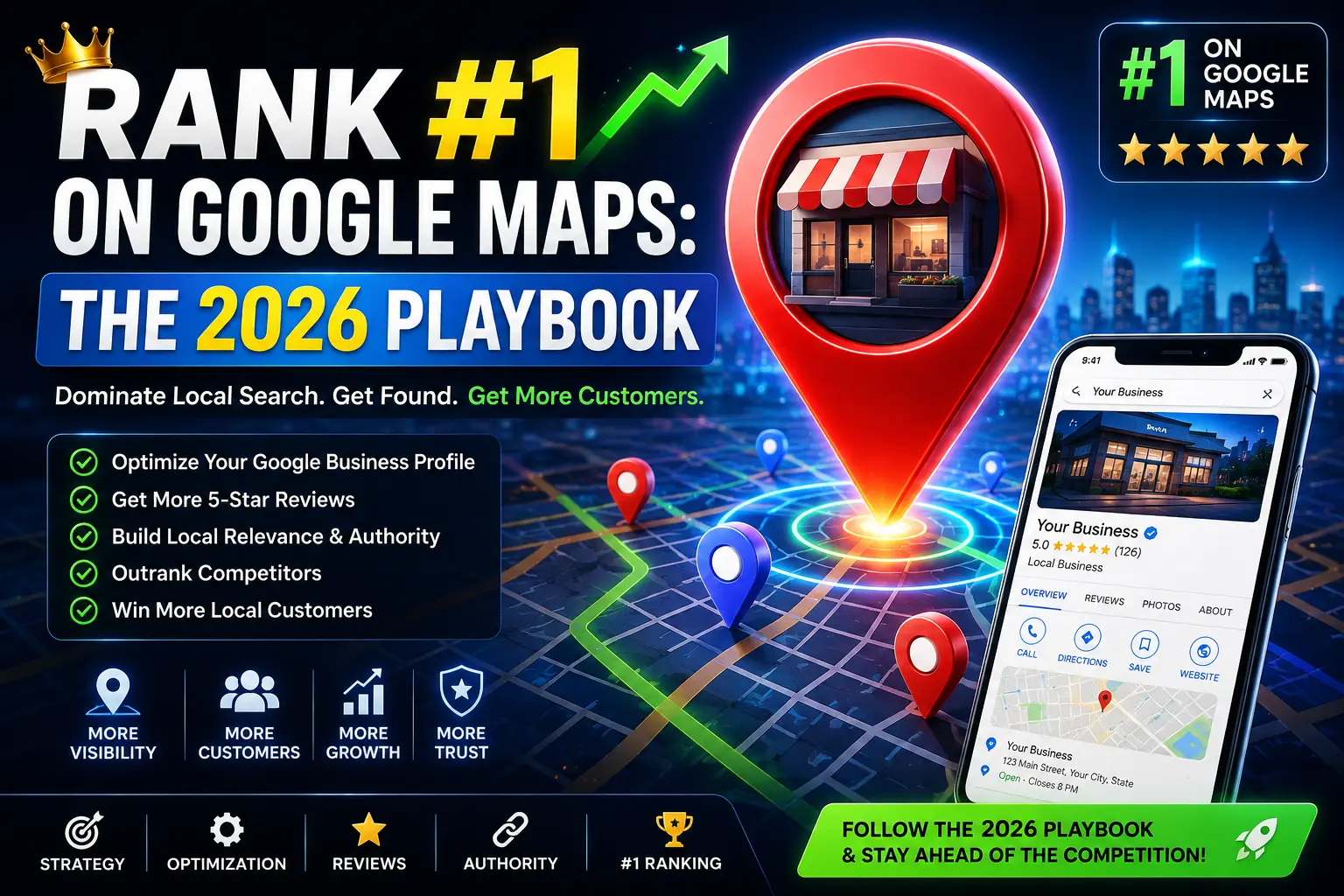
Rank #1 on Google Maps: The 2026 Playbook
Learn exactly how to rank number 1 on Google Maps in 2026, with real ranking factor data, a GBP checklist, and practical tips for local businesses.
AI Summary
Learn exactly how to rank number 1 on Google Maps in 2026, with real ranking factor data, a GBP checklist, and practical tips for local businesses.
If you run a local business, the top three spots on Google Maps aren’t just nice to have, they’re basically the whole game. Roughly 75% of all clicks in local search go to the first three businesses shown in the Maps pack, and 42% of local search traffic goes to that same top three, with everyone below scrapping over what’s left. If you’re sitting in position four or lower, you’re not slightly less visible, you’re functionally invisible to most searchers.
Here’s the encouraging part: ranking on Google Maps isn’t a mystery or a black box. Google has been fairly transparent about the three core pillars it uses, relevance, distance, and prominence, and industry research has gotten increasingly precise about exactly how much weight each specific signal carries, including how AI tools evaluate and pick local businesses using many of the same signals. That means you don’t have to guess what to work on. You can prioritize the handful of things that move the needle the most, and skip the noise.
This guide breaks down exactly what determines Google Maps rankings in 2026, backed by real data, and gives you a practical, prioritized path to actually move up the pack, not just a generic list of tips.
Why Google Maps Rankings Matter So Much Right Now
The numbers make the case better than any opinion could:
- 46% of all Google searches now carry local intent, and more than 80% of local searches show results through Maps.
- 88% of consumers who conduct a local search on their smartphone visit or call a business within a day.
- 66% of consumers say they trust Google the most when researching local businesses, ahead of Google Maps specifically at 45% and a business’s own website at 36%.
- 40.16% of local business queries now trigger Google’s AI Overviews, meaning your Maps presence increasingly feeds directly into AI generated answers too, not just the traditional map pack, a shift also driving the rise of zero-click search in local results.
If your business isn’t showing up in that top three, you’re missing the single highest intent, highest converting entry point most local customers have.
The Three Official Pillars: Relevance, Distance, Prominence
Google has stated directly that local rankings are based on three core factors. How Google determines local ranking is spelled out in the official help documentation, and everything else you’ll read about Google Maps SEO fits under one of these three umbrellas.
Relevance
How well your Google Business Profile matches what someone searched for. This is shaped by your business categories, how complete your profile is, and how well your website content actually reflects your services.
Distance
How far your business is from the person searching, or from the location included in their search. This is the one pillar you genuinely cannot control directly, though choosing accurate service areas and location settings still matters.
Prominence
How well known and well regarded your business is, both online and offline. This covers reviews, backlinks, citations, and general brand visibility across the web.
What Actually Moves the Needle: 2026 Ranking Factor Breakdown
Multiple independent studies in 2026 converge on a similar picture, even if the exact percentages vary slightly by methodology. BrightLocal’s consumer research points the same direction year after year.
| Ranking Factor Category | Approximate Weight | What It Covers |
|---|---|---|
| Google Business Profile signals | 32 to 36% | Categories, completeness, photos, posts, attributes, hours |
| On-page and citation signals | 15 to 33% | Website content, NAP consistency, local directory listings |
| Review signals | 15 to 20% | Review count, rating, velocity, response rate |
| Link signals | Up to 26% | Quality backlinks pointing to your site |
| Behavioral signals | 7 to 9% | Click through rate, click to call, direction requests |
The single clearest takeaway across all of this research: your Google Business Profile is the most powerful lever you directly control, and it’s not close.
Step by Step: How to Actually Rank Higher
1. Nail Your Primary Category First
This is consistently identified as the single most impactful, fastest moving factor available. Choosing the correct, most specific primary category can gain a business 2 to 4 positions within about three weeks. A generic or slightly mismatched category is one of the most common, easily fixed mistakes local businesses make.
Practical tip: Search for your ideal customer’s exact query and note what categories your top ranking competitors are using. Match your primary category as precisely as possible, and add relevant secondary categories to expand your reach without diluting your core relevance.
2. Complete Every Single Field on Your Profile
Businesses with complete profiles are consistently preferred by consumers, and Google treats completeness as a direct relevance signal. That means filling out your business description, all applicable attributes, service lists, and accurate hours, not just the bare minimum.
Practical tip: Treat your services list like a menu, not an afterthought. When Google can read exactly what you offer in structured fields instead of guessing from vague descriptions, it can match you to far more specific, relevant searches.
3. Fix Your NAP Consistency Everywhere
Consistent name, address, and phone number data across your Google Business Profile, website, and citations yields a measurable ranking boost, with one 2026 analysis putting the improvement at 31% for multi location businesses specifically. Inconsistent NAP data actively confuses Google’s verification systems and can suppress your visibility. For the full audit method and the numbers behind it, see our information consistency audit guide for SEO, AEO, and GEO.
4. Build a Genuine Review Strategy, Not Just a Review Count
This is where a lot of businesses get the strategy wrong. Total review count matters less than most owners assume, review velocity, a steady, consistent flow of new reviews, consistently outperforms a single burst of reviews followed by silence. Listings with 50 or more reviews and a 4.5 star or higher rating see a 61% higher chance of ranking in the top spots, and one 2026 analysis found businesses with 100 or more reviews ranking 3.2 times higher on average.
Practical tip: Aim for a steady pace of roughly 5 to 10 new reviews per month rather than trying to gather 50 reviews in a single week. Respond to every review, positive and negative, professionally and promptly; response rate itself is a signal Google tracks.
5. Post Regularly on Your Profile
Google Business Profile posts aren’t just a marketing nicety, profiles that post regularly appear in the top three map results 3.1 times more often than profiles that don’t. This is one of the lowest effort, most underused levers available.
Practical tip: Even a simple weekly post, an update, an offer, a recent project photo, meaningfully outperforms an abandoned profile that hasn’t been touched since setup.
6. Add Real, Recent Photos
Photos directly affect engagement and, by extension, the behavioral signals Google factors into rankings. Businesses that upload photos regularly, actual location photos, team photos, and completed work, rather than stock imagery, tend to see stronger engagement and dwell time.

7. Strengthen Your Website’s Local Relevance
Your Google Business Profile doesn’t operate in isolation, Google evaluates your business as a full entity, profile and website together. Dedicated service pages, location specific content, and clear geographic keyword relevance on your actual site all reinforce what your profile claims.
Practical tip: If you serve multiple areas or neighborhoods, build a genuinely useful, unique page for each rather than duplicating the same generic content with the city name swapped out. Thin, duplicated location pages tend to underperform or get filtered out entirely.
8. Earn Genuine Local Citations and Backlinks
Accurate listings on relevant local directories, industry associations, and chamber of commerce sites reinforce prominence. Quality backlinks from real, relevant local or industry sources carry meaningfully more weight than a large volume of low quality directory submissions. Our guide to free and paid backlink methods for 2026 covers the full range of options.
9. Encourage the Behavioral Signals That Prove You’re Worth Ranking
Click through rate, click to call actions, and direction requests all feed into Google’s understanding of whether your listing is actually satisfying searchers. The average local pack click through rate for the top three positions sits around 43%, which is exactly why the factors above compound on each other, a stronger profile earns more clicks, which reinforces the ranking further.
Mistakes That Quietly Sabotage Your Ranking
- Keyword stuffing your business name. Adding service terms or location names to your business name beyond your actual legal name is against Google’s guidelines and risks suspension, erasing all prior progress.
- Treating Google Business Profile and your website as separate projects. Google evaluates your full entity together; neglecting either one weakens the other.
- Using a virtual office or mailbox address for a service area business. This violates Google’s guidelines and can lead to suspension once flagged.
- Creating duplicate listings for a single location. This confuses ranking systems rather than boosting visibility, and typically backfires.
- Ignoring negative reviews or responding defensively. A professional, calm response to a negative review is itself a trust signal; silence or defensiveness is not.
- Abandoning the profile after initial setup. Profiles that go untouched for months lose the behavioral and freshness signals that active, engaged profiles benefit from.
How AI Search Is Changing Local Rankings
This is worth calling out specifically for 2026: local business queries increasingly trigger AI Overviews and AI generated answers, not just the traditional map pack. Recent research has identified new AI specific visibility factors layered on top of traditional local SEO, with an estimated review threshold of 150 or more reviews associated with a meaningfully higher chance of being cited in AI generated local recommendations.
This doesn’t replace traditional Google Maps optimization, it builds directly on top of it. The same signals, a complete profile, strong reviews, consistent NAP data, and genuine website relevance, are exactly what feed into how confidently AI systems recommend your business in a generated answer. Our guide to making your business site visible to AI walks through the site side of the same story.
How F9XR Team Helps You Actually Rank #1
Optimizing a Google Business Profile properly, categories, completeness, consistent NAP data, a genuine review strategy, regular posting, alongside the website side of local relevance, is a genuinely ongoing job, not a one time setup. Most business owners simply don’t have the bandwidth to manage all of it consistently while running the business itself.
F9XR Team handles exactly this combination through its local SEO and Google Business Profile work and website development and redesign services, building the on site local relevance Google looks for, cleaning up NAP consistency across your web presence, and making sure your Google Business Profile and your website reinforce each other as the single, trustworthy entity Google (and increasingly AI search tools) are evaluating.
Key Takeaways
- 75% of all Google Maps clicks go to the top three businesses, making local pack ranking one of the highest leverage visibility opportunities for any local business.
- Google ranks local results based on three official pillars: relevance, distance, and prominence, with your Google Business Profile as the single most controllable, highest weighted lever.
- Choosing the correct primary category can move a listing 2 to 4 positions within roughly three weeks, making it one of the fastest, highest impact fixes available.
- Review velocity, a steady, consistent flow of new reviews, matters more than raw review count, and businesses with 100 or more reviews rank roughly 3.2 times higher on average.
- Regular Google Business Profile posts alone can help a listing appear in the top three map results 3.1 times more often.
- AI search tools are increasingly citing local businesses in generated answers based on the same underlying signals, complete profiles, strong reviews, and consistent data, that drive traditional Maps rankings.
Conclusion
Ranking number one on Google Maps isn’t about a single trick or a lucky break, it’s the compounding result of a genuinely complete Google Business Profile, a real review strategy built on consistency rather than bursts, accurate data everywhere your business appears online, and a website that reinforces rather than contradicts what your profile claims. Get the fundamentals right, in the right order, and the ranking follows.
If keeping all of that consistent and current feels like more than you have time for, that’s exactly the groundwork F9XR Team builds into its local SEO, website development, and website redesign work, so your business shows up strong, accurate, and trustworthy everywhere customers, and the AI tools now helping them decide, are looking.
Further Reading
Related Questions

Keywords
Copyright
© 2026 F9XR Team. Licensed under the Creative Commons Attribution 4.0 International License (CC BY 4.0). You are free to share and adapt this work with attribution to the F9XR Team.
Disclaimer
This article reflects the experience and opinions of the F9XR Team and is provided for general informational purposes only. It is not professional legal, financial, or medical advice. Metrics and results mentioned are illustrative and not guaranteed.
F9XR/Articles, published by the F9XR Team, delivers high-quality marketing content produced by staff and contracted experts, unless otherwise noted. This commitment to quality ensures comprehensive coverage of industry topics from a trusted team of writers. For more information, please visit the F9XR Team website or reach out through the contact page.
Ready to Build a Stronger Digital Presence?
The F9XR Team helps business owners turn websites into conversion engines. From website development and redesign to local SEO and AI-powered visibility, we engineer systems that bring in results, not just traffic.
Comments