
Google's New Weather AI: WeatherNext 3 Explained
Google's new Weather AI, WeatherNext 3, brings hourly, hyper-local forecasts to Search and Maps. Here's what it means for local businesses.
AI Summary
Google's new Weather AI, WeatherNext 3, brings hourly, hyper-local forecasts to Search and Maps. Here's what it means for local businesses.
Weather is one of those things everyone checks but few people think about twice, at least until it ruins a weekend event, delays a delivery truck, or wipes out a week of outdoor sales for a local business. That’s exactly why Google’s latest announcement is worth your attention, even if you’ve never cared about meteorology in your life.
On September 3, 2026, Google DeepMind and Google Research unveiled WeatherNext 3, the company’s newest and most advanced AI weather forecasting model. It’s not a lab experiment either. Google says it’s already being rolled into Search, Google Maps, the Gemini app, Google Maps Platform, and Google Cloud, so the weather info you see across Google’s ecosystem is about to get noticeably smarter and more localized.
For business owners, startups, and local brands, this isn’t just a tech headline to skim past. Better, faster, hyper-local weather predictions can directly affect supply chains, event planning, foot traffic, delivery logistics, and even whether customers leave the house at all. In this article, we’ll break down what Google Weather AI actually does, why it matters, and how local businesses can put this shift to practical use.
What Is Google’s New Weather AI (WeatherNext 3)?
WeatherNext 3 is Google’s flagship AI weather forecasting model, built by teams at Google DeepMind and Google Research. It’s designed to replace the traditional physics-based simulations that have powered weather forecasting for decades with a deep learning model trained directly on real-world observational data.
According to Google, the model now feeds into weather information across:
- Google Search, the weather snippets you see when you search “weather today”
- Google Maps, localized conditions layered into navigation and planning
- Gemini, conversational weather answers inside Google’s AI assistant
- Google Maps Platform, for developers building weather-aware apps
- Google Cloud, for researchers and businesses needing raw forecast data
Samier Merchant, a senior staff engineer at Google, described this as a milestone moment, noting it’s the first time core weather variables generated by this kind of model will directly power so many Google products simultaneously. The official announcement fills in the technical details.
How WeatherNext 3 Is Different From Older Forecasting Models
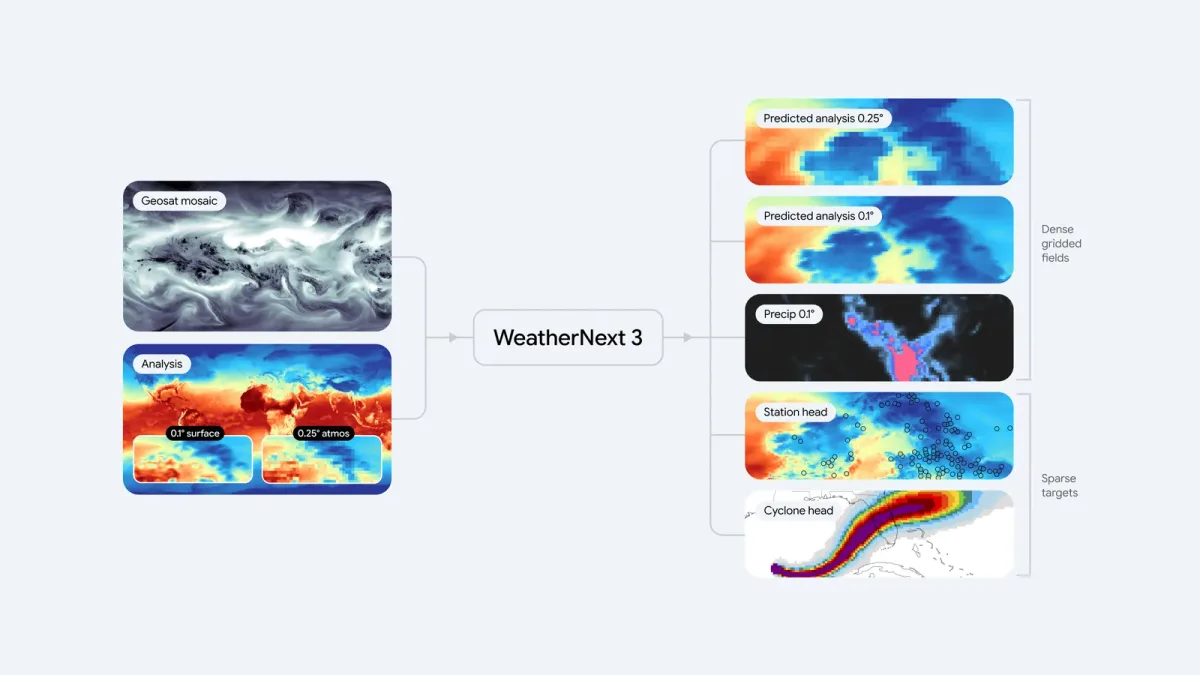
Traditional forecasting relies on physics-based simulations that model the atmosphere using complex equations, updated periodically using data collected from weather stations and satellites. WeatherNext 3 takes a fundamentally different approach.
Instead of relying only on periodic data updates, the model trains directly on:
- Live geostationary satellite mosaics, refreshed roughly every hour
- Surface observations from weather stations, regional mesonet networks, and ocean buoy records
- High-resolution precipitation data, including satellite-based rainfall products
Because satellite imagery now arrives within about an hour instead of the traditional six-hour gap, the model can refresh its forecasts hourly instead of every six hours, a meaningful jump for anything involving fast-changing conditions like storms or sudden rainfall.
The Numbers Behind the Upgrade
Google has shared some specific performance claims for WeatherNext 3, and they’re worth breaking down individually rather than taking as one blanket “it’s better now” statement.
| Metric | Improvement | What It Means |
|---|---|---|
| Forecast resolution | Down to 5 km for temperature and moisture | Weather can now be predicted differently for areas just a few kilometers apart |
| Update frequency | Every hour, up from every 6 hours | Forecasts reflect real-time conditions much faster |
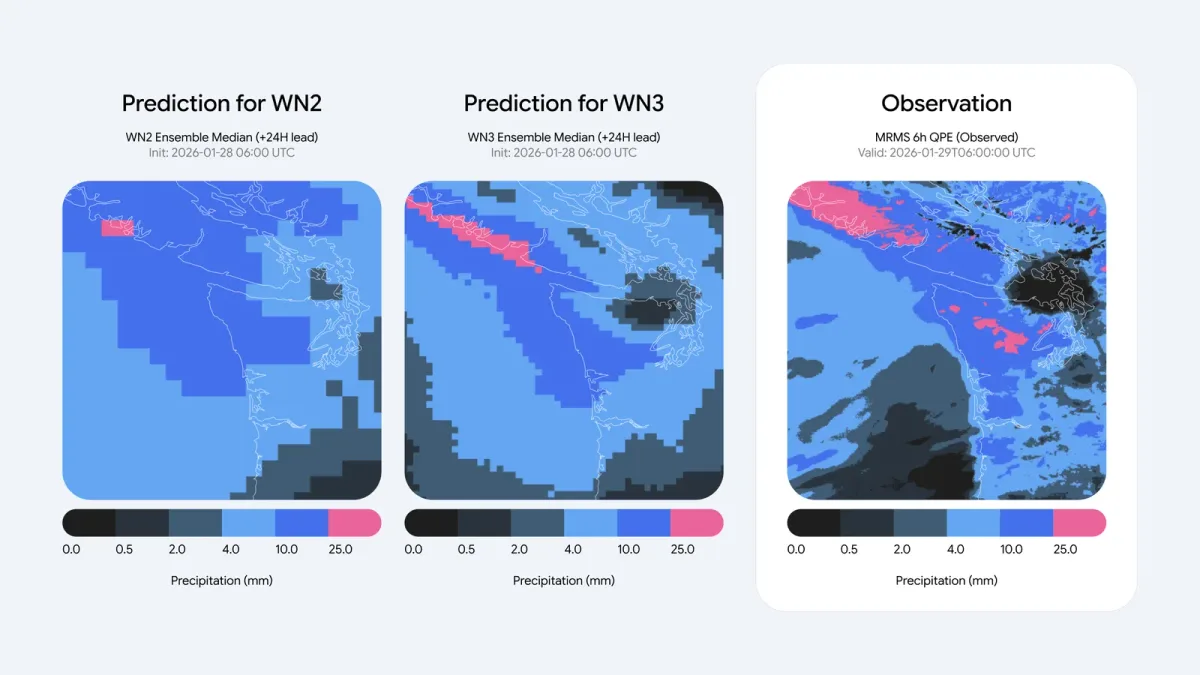
| Precipitation accuracy | Up to 50% more accurate a day or more ahead | Better rain and storm predictions for planning purposes |
| Forecast horizon | 15-day outlook, 64 ensemble scenarios | More reliable longer-range planning with built-in uncertainty ranges |
| Model size | 2.4x more parameters than WeatherNext 2 | Greater capacity to capture complex atmospheric patterns |
Google also reports that WeatherNext 3 outperformed rival AI weather systems built by Microsoft, Nvidia, and the European Center for Medium-Range Weather Forecasting when tested on Operational WeatherBench, an independent benchmarking tool built by the startup Brightband. It reportedly beat traditional government forecasting systems as well, and TechCrunch’s coverage walks through the rollout.
One caveat to keep in mind: terms like “hourly,” “5 km,” and “15 days” describe different capabilities of the model rather than one single forecast product available instantly at the finest resolution everywhere. The 5 km resolution applies to specific surface variables like temperature and moisture, while wind speed forecasts currently run at a coarser 25 km resolution.
Why Google Weather AI Matters for Local Businesses and Startups
It’s easy to assume weather AI is only relevant to meteorologists or farmers, but the ripple effects reach much further into everyday business operations.
1. Outdoor Events and Local Retail
If you run a restaurant with outdoor seating, a farmers market stall, or a retail store that depends on foot traffic, hourly and hyper-local forecasts mean you can make same-day staffing and inventory decisions with more confidence.
2. Delivery and Logistics
Startups running last-mile delivery, food delivery, or courier services can use more accurate short-term rain and storm predictions to adjust routes, delivery windows, and customer communication in real time.
3. Construction and Field Services
Contractors, landscapers, and field service businesses often lose entire workdays to unexpected weather. More frequent, localized updates mean fewer surprises and better scheduling accuracy.
4. Renewable Energy and Agriculture
Google specifically highlighted that higher-resolution wind, rain, and cloud cover forecasts will help make renewable energy projects more dependable, while better precipitation forecasting supports agricultural planning. Even Bill Gates has pointed to AI-powered weather forecasting as a meaningful benefit for improving crop yields, particularly in developing regions.
5. Local SEO and Discovery
Here’s a less obvious angle. As Google increasingly layers AI-generated context like weather conditions into Search and Maps results, local businesses that show up clearly in these AI-enhanced experiences stand to benefit from more relevant, context-aware visibility. A well-optimized Google Business Profile paired with strong local SEO means your business is positioned to benefit when Google surfaces smarter, more contextual local information to nearby customers. We covered how AI systems pick which local businesses to recommend in an earlier piece on how AI chooses local businesses.
Practical Tips for Business Owners
Here’s how to actually put this update to use, rather than just reading about it.
- Check hourly forecasts before committing to outdoor plans. If your business depends on weather-sensitive foot traffic, get in the habit of checking Google’s updated hourly forecasts each morning rather than relying on a single daily outlook.
- Build weather-aware messaging into customer communication. Delivery businesses and service providers can proactively notify customers about weather-related delays using more reliable short-term forecasts.
- Use Google Cloud access if you’re a developer. Startups building location-based or logistics apps can integrate WeatherNext 3 data directly through Google Cloud and Google Maps Platform for more accurate in-app forecasting.
- Don’t treat AI forecasts as guaranteed. Even with major improvements, Google’s own data shows regional performance varies, and best-case accuracy figures haven’t yet been independently verified by national meteorological services. Use forecasts as a strong guide, not an absolute guarantee.
- Pair smarter forecasting with smarter local visibility. If weather-driven decisions affect your foot traffic or bookings, make sure your website and local listings are optimized so customers can quickly find your hours, availability, and updates when conditions change. That’s where structured answer engine optimization work pays off.
Key Takeaways
- Google launched WeatherNext 3, its most advanced AI weather forecasting model, on September 3, 2026, built by Google DeepMind and Google Research.
- The model is now integrated into Google Search, Maps, Gemini, Google Maps Platform, and Google Cloud.
- WeatherNext 3 offers up to 5 km resolution forecasts, hourly updates, and up to 50% more accurate precipitation predictions a day or more ahead.
- It trains directly on real-time satellite data and ground observations rather than relying solely on traditional physics simulations.
- Local businesses in retail, delivery, construction, and field services can benefit from more reliable, hyper-local forecasting for daily operational decisions.
- Independent benchmarking shows WeatherNext 3 outperforming rival AI systems from Microsoft, Nvidia, and European forecasting agencies, though some accuracy figures haven’t yet been independently verified.
- As Google layers smarter, AI-driven context into Search and Maps, strong local SEO becomes even more valuable for business visibility.
How the F9XR Team Can Help
Big shifts in how Google delivers information, whether it’s smarter weather data or AI-powered search experiences, all point to the same conclusion: businesses need a digital presence that’s ready to keep up.
The F9XR Team helps small businesses, startups, and local brands stay visible and competitive as Google’s product lineup keeps evolving, through:
- Website development and redesign that keeps your site fast, mobile-friendly, and built to perform well across Google’s evolving search experiences
- Local SEO services that make sure your business shows up clearly when nearby customers are searching, checking maps, or asking AI assistants like Gemini for recommendations
- Digital presence strategy that accounts for how customers now discover businesses through both traditional search and AI-driven tools
- Guidance on how to align your online presence with Google’s increasingly AI-integrated products, so your business benefits rather than gets left behind
If Google is investing this heavily in smarter, real-time, localized information, it’s a good moment to ask whether your business’s own digital presence is just as sharp. Teams working on AI visibility optimization are already treating these shifts as standard practice, and tracking how AI surfaces citations and visibility is one of the most effective levers as this plays out.
Conclusion
Google’s rollout of WeatherNext 3 is a clear sign of how deeply AI is reshaping even the most everyday parts of our digital lives, right down to whether you’ll need an umbrella tomorrow. For local businesses and startups, the real opportunity isn’t just better weather data. It’s understanding how Google’s broader shift toward smarter, real-time, AI-driven information affects how customers search, plan, and make decisions every day.
As Google continues weaving AI deeper into Search, Maps, and Gemini, staying visible and relevant in these experiences matters more than ever. Whether that means having a website built to perform well across evolving search features, or local SEO that keeps your business easy to find, the F9XR Team helps businesses build a digital presence that’s ready for exactly this kind of shift.
Produced using AI-assisted research and drafting workflows, then reviewed and edited by the F9XR editorial team. See our Editorial Policy for how we create and verify content.
Further Reading
Related Questions

Keywords
Copyright
© 2026 F9XR Team. Licensed under the Creative Commons Attribution 4.0 International License (CC BY 4.0). You are free to share and adapt this work with attribution to the F9XR Team.
Disclaimer
This article reflects the experience and opinions of the F9XR Team and is provided for general informational purposes only. It is not professional legal, financial, or medical advice. Metrics and results mentioned are illustrative and not guaranteed.
F9XR/Articles, published by the F9XR Team, delivers high-quality marketing content produced by staff and contracted experts, unless otherwise noted. This commitment to quality ensures comprehensive coverage of industry topics from a trusted team of writers. For more information, please visit the F9XR Team website or reach out through the contact page.
Ready to Build a Stronger Digital Presence?
The F9XR Team helps business owners turn websites into conversion engines. From website development and redesign to local SEO and AI-powered visibility, we engineer systems that bring in results, not just traffic.
Comments